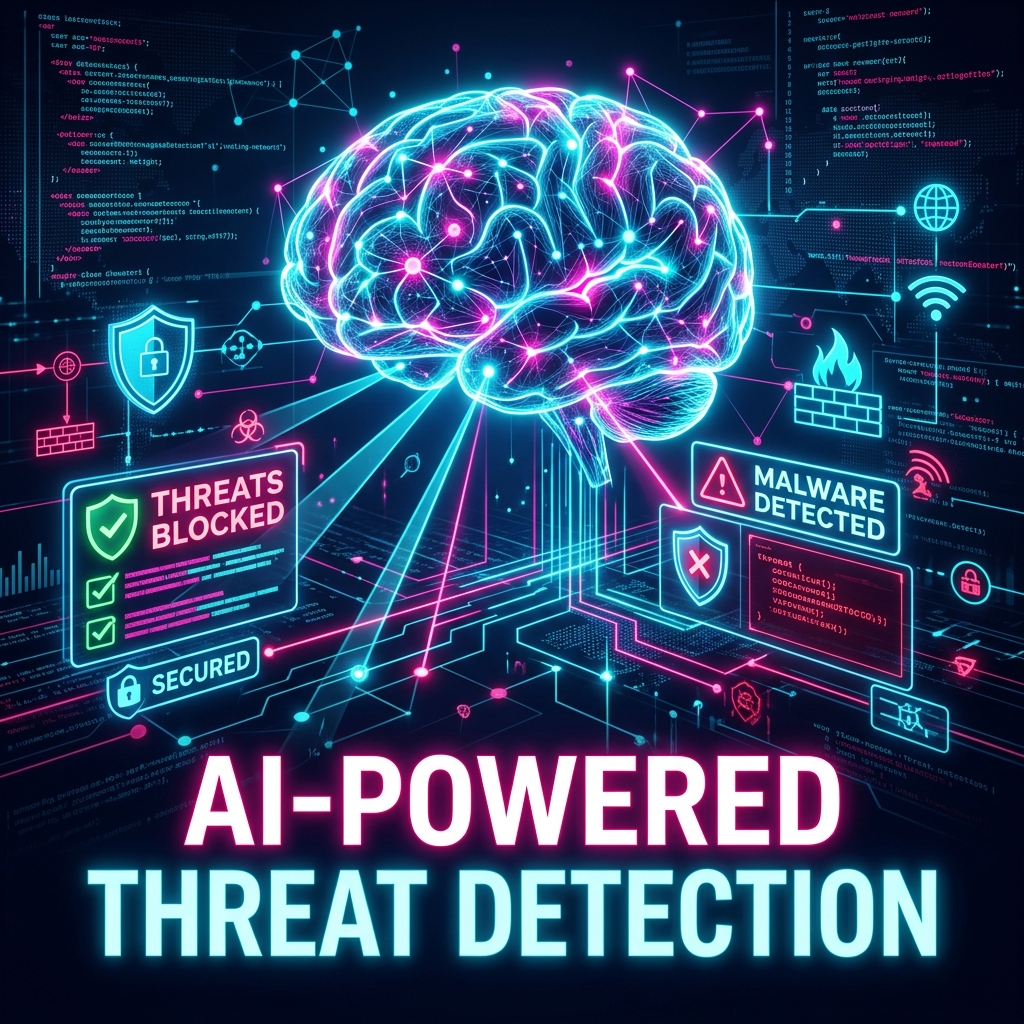
The modern Security Operations Center (SOC) is drowning in data. With thousands of alerts per day, human analysts can't keep up — and attackers know it. Enter Artificial Intelligence: the force multiplier that's turning overwhelmed SOC teams into precision threat-hunting machines.
The Alert Fatigue Crisis
The average enterprise SOC receives over 11,000 alerts daily. Studies show that 45% of these are false positives, yet every single one demands attention. This creates a dangerous cycle:
- Analysts become desensitized to alerts ("alert fatigue")
- True positives get buried in noise
- Mean Time to Detect (MTTD) increases
- Attackers gain critical dwell time
"AI doesn't replace the analyst — it amplifies their capabilities by orders of magnitude, letting them focus on what humans do best: creative problem-solving and strategic thinking."
How AI Transforms Threat Detection
AI-powered security tools leverage several machine learning paradigms to detect threats that traditional rule-based systems miss:
Supervised Learning — Known Threat Classification
Models trained on labeled datasets of known malware, phishing URLs, and attack patterns. They classify incoming data as malicious or benign with high accuracy.
# Simplified malware classification example
from sklearn.ensemble import RandomForestClassifier
from sklearn.model_selection import train_test_split

# Features: file entropy, import count, section count, etc.
X_train, X_test, y_train, y_test = train_test_split(
    features, labels, test_size=0.2, random_state=42
)

clf = RandomForestClassifier(n_estimators=200, max_depth=15)
clf.fit(X_train, y_train)
accuracy = clf.score(X_test, y_test)
print(f"Detection accuracy: {accuracy:.2%}")  # ~97.3%
Unsupervised Learning — Anomaly Detection
These models learn "normal" behavior patterns and flag deviations. Perfect for detecting zero-day attacks, insider threats, and lateral movement that have no known signature.
- User and Entity Behavior Analytics (UEBA) — Baseline user behavior and alert on anomalies (unusual login times, data exfiltration patterns, privilege escalation)
- Network Traffic Analysis — Detect command-and-control beaconing, DNS tunneling, and unusual data flows
- Log Clustering — Group related events that individually seem benign but together indicate a coordinated attack
Deep Learning — Advanced Pattern Recognition
Neural networks excel at analyzing unstructured data like malware binaries, encrypted traffic patterns, and natural language in phishing emails. Convolutional Neural Networks (CNNs) can detect malware by analyzing binary files as grayscale images.
Real-World Applications
1. Automated Triage & Prioritization
AI assigns risk scores to every alert, automatically escalating critical threats while suppressing false positives. This reduces analyst workload by up to 70%.
2. Predictive Threat Intelligence
ML models analyze global threat feeds, dark web chatter, and vulnerability databases to predict which attack vectors are most likely to target your organization next.
3. Automated Incident Response (SOAR)
Security Orchestration, Automation and Response platforms use AI to automatically contain threats — isolating compromised endpoints, blocking malicious IPs, and rotating credentials — all within seconds of detection.
Challenges & Limitations
AI in security isn't a silver bullet. Here are the key challenges:
- Adversarial AI — Attackers are using adversarial machine learning to evade detection models (e.g., polymorphic malware that mutates to avoid classification).
- Data Quality — ML models are only as good as their training data. Incomplete or biased datasets lead to high false positive/negative rates.
- Explainability — "Black box" models make it hard to understand why an alert was triggered, which is critical for incident response and compliance.
- Resource Intensity — Training and running deep learning models requires significant compute resources.
Getting Started with AI Security
If you're looking to integrate AI into your security operations, here's a pragmatic approach:
- Start with UEBA — Implement User and Entity Behavior Analytics as your first AI-powered tool. It provides immediate value with relatively low complexity.
- Augment, Don't Replace — Use AI to assist human analysts, not replace them. Human intuition and context remain irreplaceable.
- Invest in Data Pipelines — Clean, normalized, and comprehensive data is the foundation of effective AI. Fix your data before buying AI tools.
- Upskill Your Team — SOC analysts need to understand how AI models work to effectively use and tune them.
Conclusion
AI-powered threat detection isn't the future — it's the present. Organizations that embrace ML-driven security gain a decisive advantage: faster detection, fewer false positives, and automated response capabilities that keep pace with modern threats.
At Netrinix Academy, our AI in Cybersecurity course teaches you to build and deploy these models hands-on. From feature engineering to production deployment — learn the skills that the industry demands.